The Xone Bass Boost: We Tested the Myth So You Don't Have To

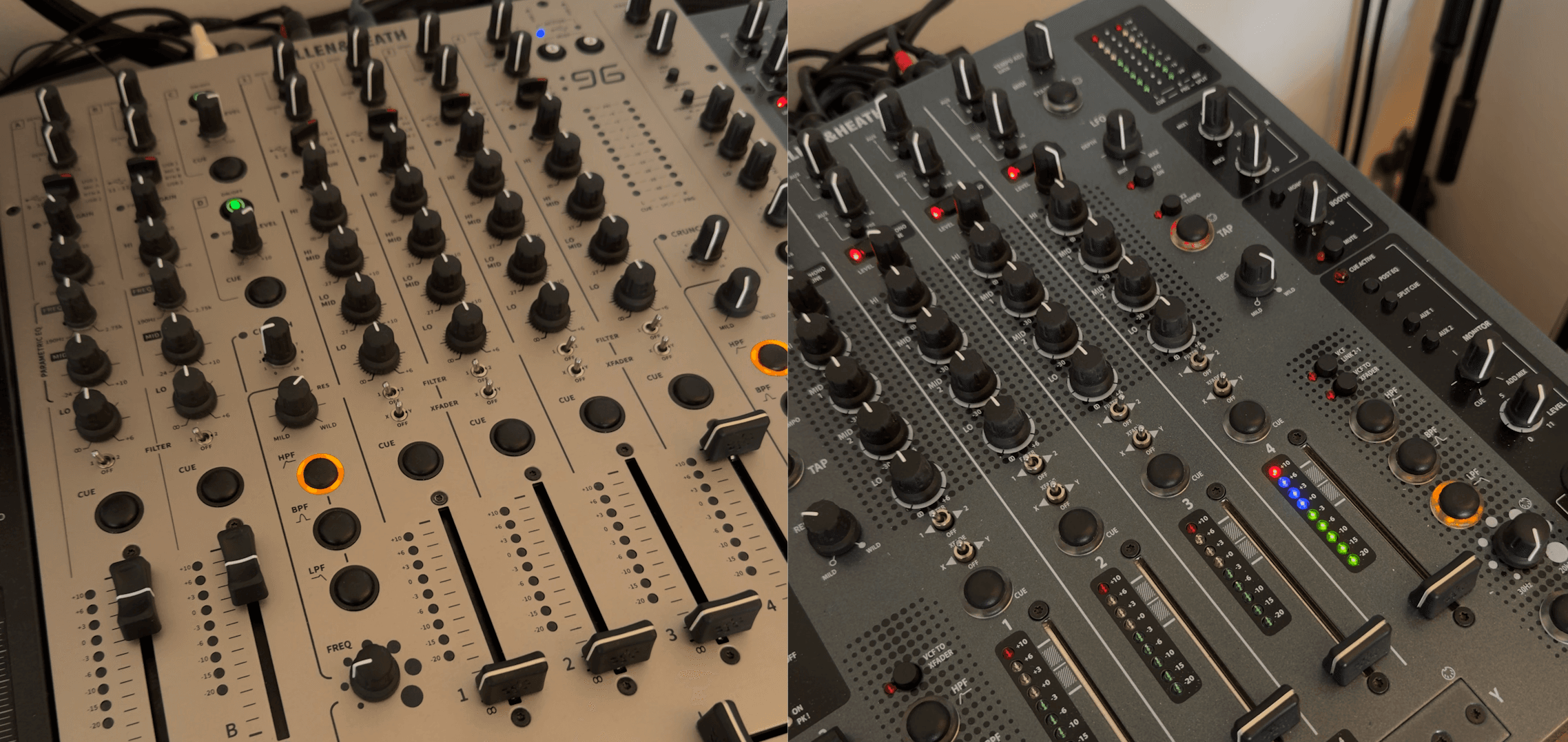
If you've spent any time around DJs who play on Allen Heath gear, you've probably heard it. Someone leans over between sets and mentions that you can actually boost your low end on a Xone mixer using the high pass filter. Not cut it, boost it. The same filter that's supposed to remove bass.
It sounds like the kind of thing that gets passed around booths without anyone ever actually checking. So we put it to the test on both the Xone:92 and the Xone:96, measuring the actual frequency response at different resonance settings. Here's what we found, what it means for your mix, and whether you'd ever actually want to use it.
What the Myth Says
The claim is this: engage the HPF on a Xone mixer, leave the frequency sweep in its idle position (all the way counter-clockwise, around 20 Hz), crank the resonance, and you'll add low end rather than remove it.
At face value that seems backwards. A high pass filter is designed to cut bass frequencies. The resonance control on the Xone VCF adjusts the Q, which sharpens the filter cutoff and creates that characteristic resonant peak. On classic analogue synths, cranking resonance on a filter with the cutoff set low can cause the filter to self-oscillate and produce a strong tonal peak in the sub range. The Xone VCF is a state-variable analogue filter, directly descended from that same design philosophy. So the myth isn't completely without technical basis.
But what does it actually do to your audio?
What Actually Happens When You Turn the Filter On
The first thing to know is that turning the HPF on at all has an audible effect, even before you touch the resonance. With the frequency sweep at minimum and resonance set to mild, engaging the filter immediately cuts a noticeable amount of low end. The signal is physically being routed through different analogue circuitry the moment you press that switch, and the character of the sound changes as a result.
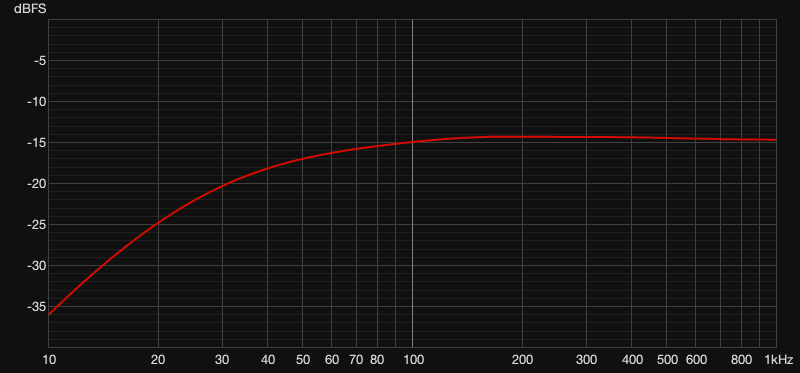
Frequency response graph of the Xone:96 HPF with zero resonance, showing significant bass cut below 100 Hz
As you increase the resonance, the opposite starts to happen. The cut gets less and less pronounced. The filter's resonant peak is building in the sub-bass region and compensating for the roll-off.
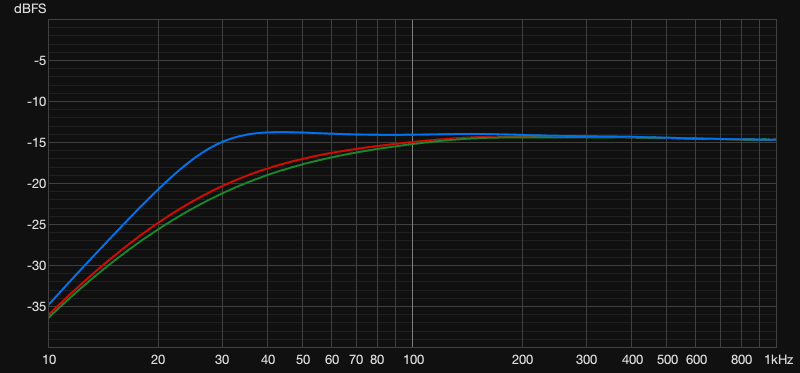
Xone:96 HPF frequency response comparison across three resonance settings
Keep going, all the way to the wild end of the resonance dial, and at full resonance the compensation overshoots. You end up with a genuine boost below 100 Hz.
So the myth checks out. The Xone HPF resonance bass boost is real.
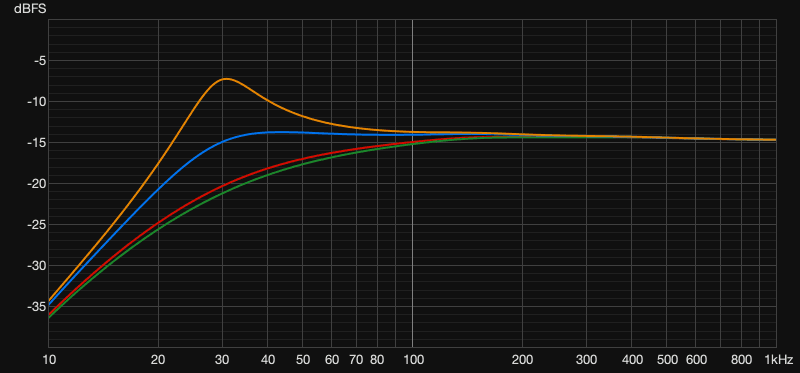
Xone:96 HPF at full resonance showing a bass boost peak around 30 Hz
The Xone Bass Boost: 92 vs 96
Here's where it gets interesting. Both mixers produce the effect, but they do it differently.
The Xone:96 boosts frequencies centred around 30 Hz by approximately 7 dB at full resonance. That's deep sub bass territory, the kind of frequencies you feel more than hear, the weight under a kick drum or the pressure from a bass synth at low volume.
The Xone:92 peaks lower, around 15 Hz, and by a slightly smaller amount. At 15 Hz you're getting into the range that's barely audible on most club systems and felt almost entirely as physical air pressure through subwoofers. Whether that translates to a perceived bass boost in the room depends heavily on the PA system and the venue.
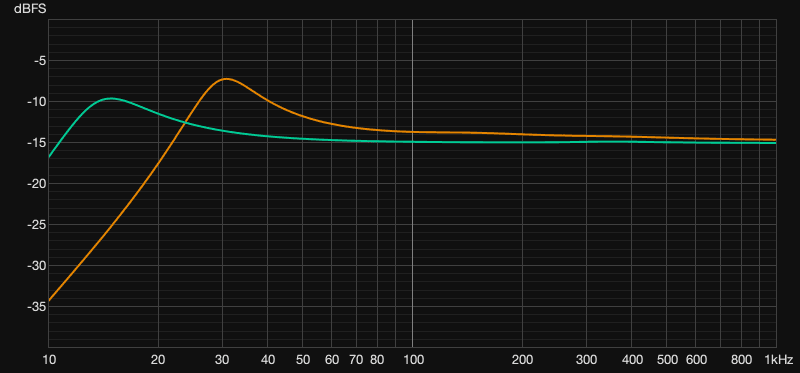
Xone:96 (yellow) vs Xone:92 (green) HPF bass boost comparison at full resonance
In practical terms the Xone:96 boost is more likely to be audible. 30 Hz is still within the usable range of most club subwoofers. The Xone:92 version sits closer to the edge of what most systems can reproduce.
Neither mixer produces a flat frequency response with this trick. You're adding a resonant peak, which is a coloured, shaped bump rather than a clean gain increase across the low end. It will affect different tracks differently depending on how much content they have in that frequency range.
Does the Boost Matter in Practice?
That depends on two things: the system you're playing on and how well-produced the tracks you're playing already are.
On a large club system with high-quality subwoofers, a 7 dB boost centred at 30 Hz is absolutely going to be felt. Whether that's useful or just adds mud depends on the music and the room. In an acoustically problematic venue where the sub already builds up, you probably don't want more of it.
There's also the question of whether your tracks actually need it. Well-mastered electronic music already has intentional low-end content. Adding 7 dB to that range with a resonant peak changes the way the track was intended to sit. The producer and mastering engineer made decisions about how much sub is in there.
That said, there are legitimate scenarios where you might want it: a system that's running lean in the sub, a track that feels thin in the mix, or a moment where you want to deliberately add weight before a drop.
The catch is precision. You can't dial in a specific amount of boost with this technique. It's all-or-nothing at full resonance, and the frequency point shifts depending on your sweep position. You're relying on feel rather than measurement.
Know Your Signal Chain
This is where consistent loudness becomes relevant. If you're using the Xone HPF resonance trick, you're adding a significant resonant peak to your output, which can cause perceived loudness to spike in ways that aren't always obvious on the mixer meters. Bass frequencies at high levels load subwoofers and amps differently than a flat signal.
This is one of many reasons why knowing what your tracks are doing before they hit the mixer matters. When you use waveAlign to normalize your library to a consistent LUFS target, you start every track at the same baseline. If you then choose to apply a technique like the Xone bass boost, you're making a deliberate creative decision on top of a controlled foundation, not compensating for a track that was already louder or bassier than everything else.
The filter trick isn't a substitute for gain structure. It's a tool, and like any tool it works better when the signal coming into it is predictable.
Frequently Asked Questions
Does the Xone HPF really boost bass? Yes. With the high pass filter engaged, the frequency sweep at minimum, and the resonance turned to maximum, both the Xone:92 and Xone:96 produce a measurable boost in the sub-bass region. The effect is produced by the resonant peak of the analogue VCF filter circuit.
What is the difference between the Xone:92 and Xone:96 bass boost? The Xone:96 boosts around 30 Hz by approximately 7 dB at full resonance. The Xone:92 peaks closer to 15 Hz by a slightly smaller amount. The 96's boost sits higher in frequency and is more likely to be audible on club systems.
Will turning on the HPF always cut bass? Yes, initially. Engaging the HPF with low resonance immediately reduces low-end content, even with the sweep at its minimum position. The bass reduction decreases as you increase resonance, and only reverses into a boost at the top of the resonance range.
Is the Xone bass boost usable in a live DJ set? It can be, but use it deliberately. The boost is a resonant peak, not a clean lift, and it adds colour to the signal. It's most useful on systems that are running light in the sub. Be aware that engaging and disengaging the HPF at any resonance setting will change your low-end content, so treat it as a creative effect rather than a subtle EQ move.
Does the Xone bass boost affect loudness? Yes. A 7 dB boost below 100 Hz adds significant energy to the signal, which affects both perceived loudness and the load on subwoofers and amplifiers. If you're managing consistent loudness across your set, account for it.
Conclusion
The Xone bass boost myth is confirmed. Engage the HPF, leave the sweep low, push the resonance to wild, and both the Xone:92 and Xone:96 produce a genuine boost in the sub-bass range. The 96 hits around 30 Hz at roughly 7 dB. The 92 digs a little deeper at 15 Hz with slightly less output.
Whether you use it comes down to your system, your music, and how intentional you want to be. It's a real tool with real results, and now you know exactly what it's doing.
If you want your tracks to hit that filter from a consistent baseline, waveAlign normalizes your entire library to a broadcast-standard LUFS target so every track starts equal. One less variable to manage between the music and the crowd.
Like what you see? Share with a friend.
Yannik Brehm
Yannik is a multifaceted professional whose career merges audio-engineering, software-development and music production. Currently working as a Senior Audio System Engineer specializing in automotive audio solutions and embedded development, he leverages a Master's degree in Media Informatics and experience in professional real-time audio software development for companies like Sennheiser. His technical expertise is complemented by practical knowledge and critical listening skills gained through years of producing, mixing and mastering electronic music.
Ready for perfectly balanced audio?
Try waveAlign and experience consistent loudness across your entire library.
Buy Now