Pioneer Mixer Isolator vs EQ Mode: What's Actually Different

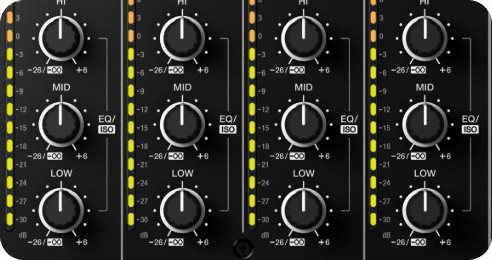
You've probably noticed the small switch on your Pioneer DJM that toggles between EQ and isolator mode. Most DJs flip it once, decide they prefer one, and never think about it again. But understanding the Pioneer mixer isolator vs EQ mode difference goes deeper than "one kills the frequency and one doesn't." The behavior changes depending on where your knob is sitting, and that has real consequences for how you transition and blend.
This article breaks down exactly how each mode behaves across the knob's full rotation, where the two curves cross over, and what that means for your mixing decisions.
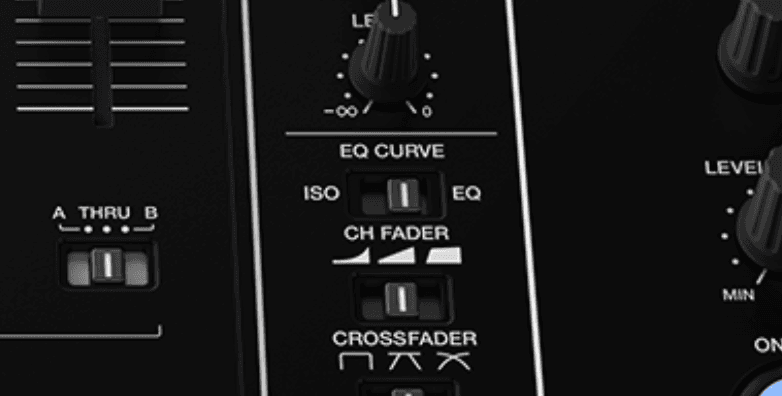
The tiny switch with huge implications
Pioneer Mixer Isolator vs EQ Mode: Kill vs Cut
At its simplest, the difference comes down to the floor.
Standard EQ mode applies a shelving curve that reduces a frequency band to a maximum of around -26dB when the knob is fully turned. That is a significant cut, but it is not silence. Some signal from that band still bleeds through.
Isolator mode takes that same knob travel and ends at complete elimination, a full kill. Turn the bass to the stop and the bass is gone. Not nearly gone, actually gone.
That end-point difference is what most DJs think about when choosing between the two. But it is only half the picture.
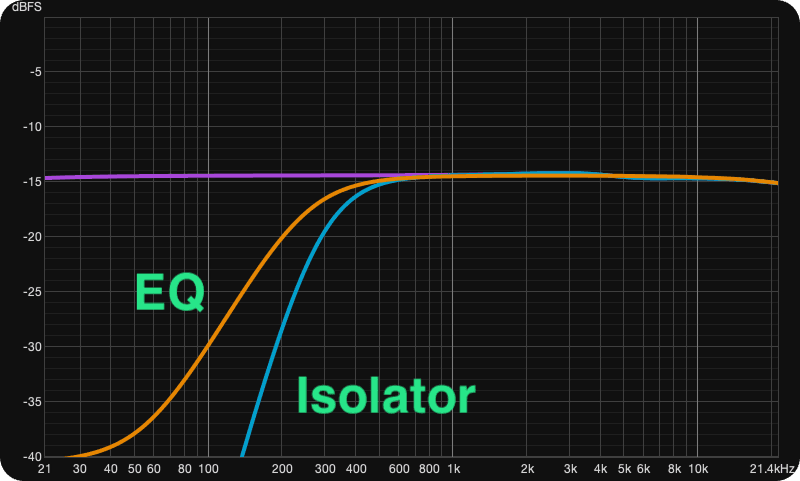
The EQ curve (orange) rolls off the low band faster than isolator mode (blue) at equivalent knob positions.
How Each Mode Behaves Across the Knob
Here is where it gets interesting, and where most explanations stop short.
When you barely touch the knob, just a slight turn from center, the two modes do not behave the same way. EQ mode actually reduces more at small knob positions. It has a steeper initial curve. Turn it a little and EQ mode shaves off noticeably more than isolator mode does.
As you continue turning, that steeper slope holds. For a solid portion of the knob's range, EQ mode is cutting harder than isolator at the equivalent position. If you are making subtle, surgical adjustments, that responsiveness means a small move goes further.
Isolator mode starts gentler. Its curve is shallower through the early and middle range of rotation. The reduction builds more gradually across a wider arc of the knob.
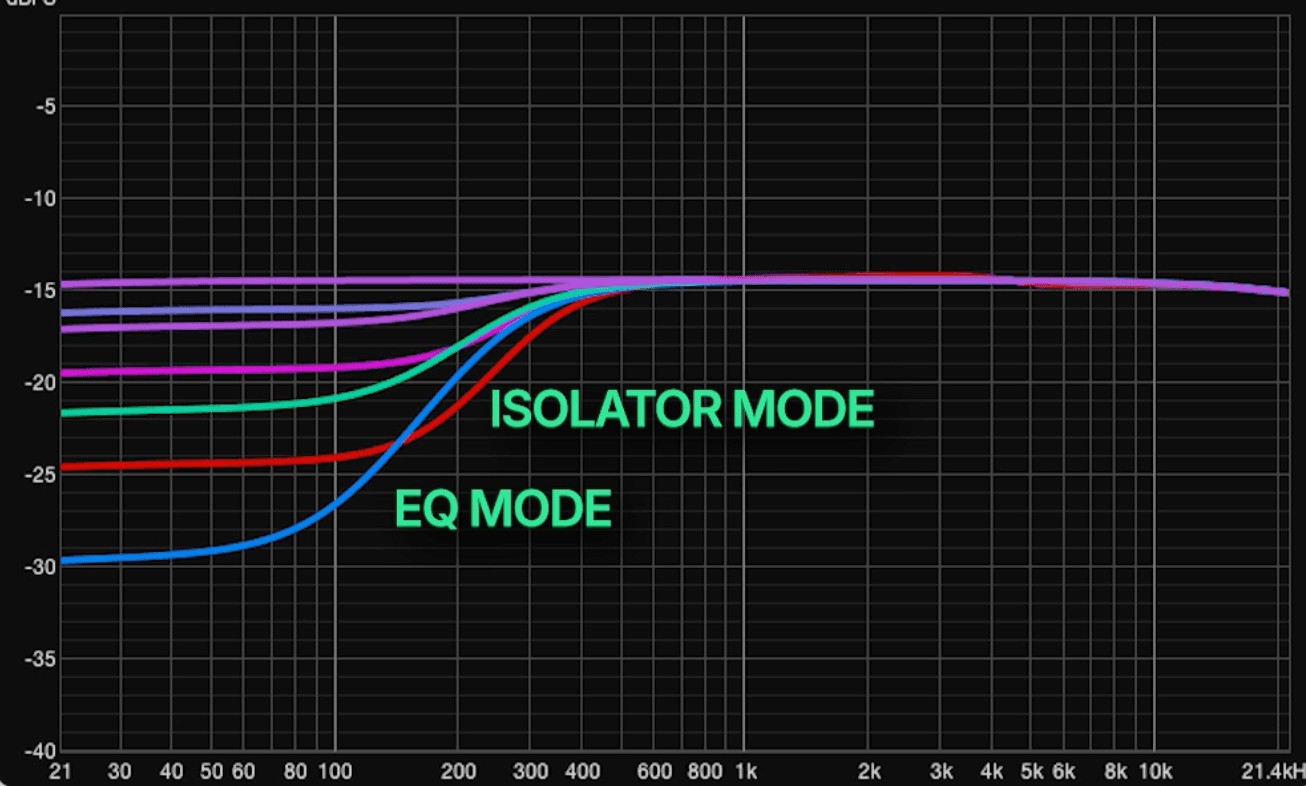
At 9 o'clock, EQ mode is already cutting deeper than isolator at the same position.
The Crossover Point: Where Isolator Overtakes EQ
The two modes do not stay in that relationship all the way to the stop. At roughly the midpoint of the knob's rotation, isolator overtakes EQ in reduction strength. Past that crossover, isolator is cutting harder than EQ mode would at the same position.
This happens because the isolator curve has to bring the signal all the way to zero by the time the knob bottoms out. To achieve full kill, the curve steepens sharply in the latter half of its travel. EQ mode, with no obligation to reach zero, does not need that late acceleration. Its curve flattens out and levels off before it gets there.
In practical terms: early knob movement is more responsive in EQ mode. Late knob movement is more aggressive in isolator mode.
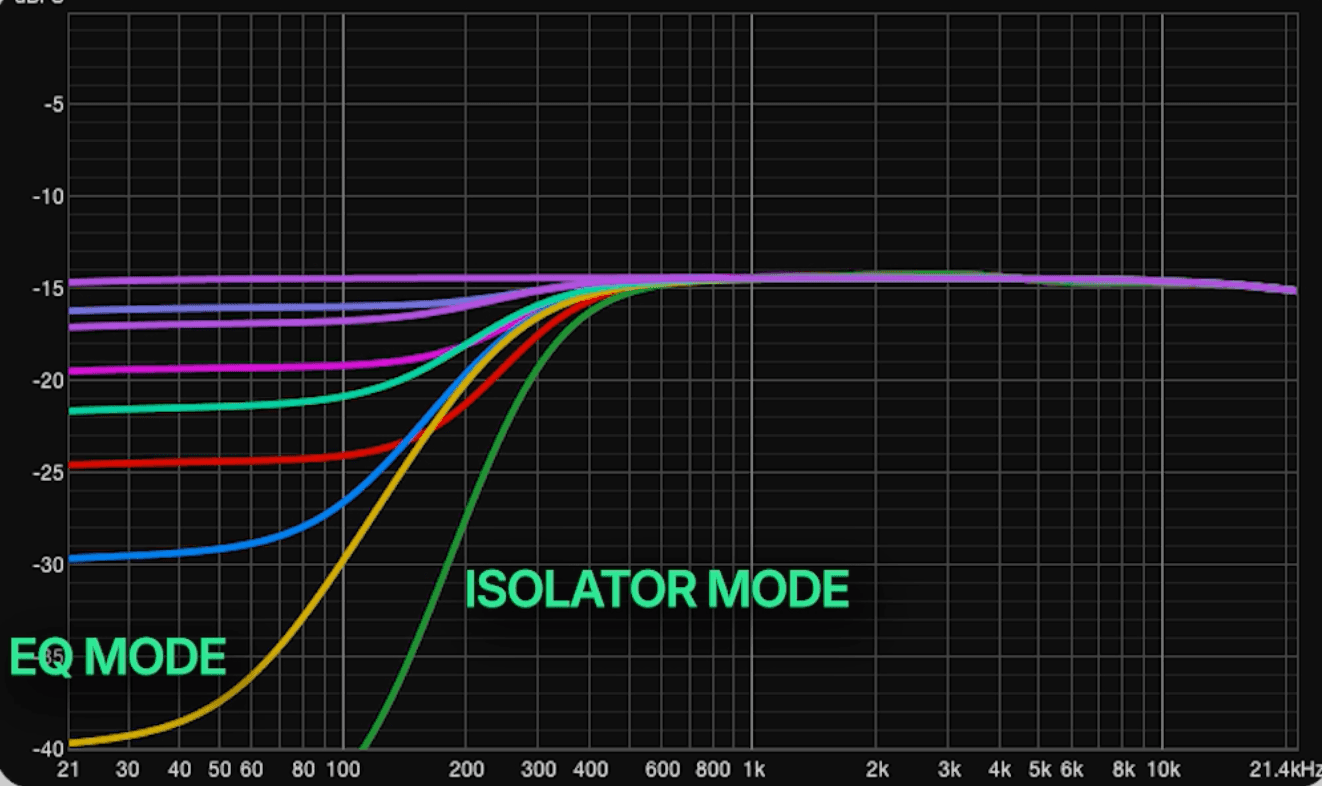
Full knob range overlaid. EQ mode leads early, isolator takes over in the second half and goes all the way to silence.
Which Mode Suits Which Style
Neither mode is objectively better. They suit different approaches.
Isolator mode works well if:
- You want to do full-band frequency swaps between tracks, pulling one track's bass out completely while introducing another's
- You mix in genres where a hard bass cut is a performance move, not just a blend tool
- You want to use the EQ knobs like volume faders for individual frequency bands, using the DJM EQ kill switch approach to bring tracks in and out
EQ mode works well if:
- You prefer gradual, blended transitions where small adjustments feel natural and proportional
- You are making tonal corrections mid-mix rather than dramatic cuts
- You want more precision in the early range of the knob, where most of your actual mixing happens
A lot of DJs choose isolator mode thinking it gives them more control because of the full kill. But for subtle work in the first half of knob travel, standard EQ mode is the more responsive tool for DJ EQ mixing technique.
Keeping Your Levels Consistent Either Way
One thing both modes share: they interact with your overall gain structure. Cutting a frequency band, especially the low end, changes how a track reads to the room. A bass-reduced track sounds quieter, and when that bass comes back in, whether at -26dB with EQ mode or from complete silence with isolator, the perceived level shift hits differently.
This is one place where having your tracks normalized to a consistent loudness before you play matters. If your tracks are already sitting at different levels coming in, that frequency swap becomes harder to land cleanly. You are managing both the EQ movement and a gain inconsistency at the same time.
waveAlign normalizes your entire library to a broadcast-standard LUFS target before you play. Every track starts at the same loudness, so when you are working the EQ, you are only thinking about the EQ. It processes non-destructively, without touching your metadata, cue points, or the dynamics of the track. Precise moves with both isolator and EQ mode become more repeatable because the starting point is always consistent.
Frequently Asked Questions
What is the difference between isolator and EQ mode on a Pioneer mixer? Isolator mode allows a frequency band to be completely eliminated when the knob is fully turned. Standard EQ mode maxes out at around -26dB, meaning some signal from that band always remains. The two modes also behave differently across the knob's travel, with EQ mode being more responsive early in the rotation and isolator becoming more aggressive in the latter half.
Does isolator mode give you more control than EQ mode? Not always. Isolator mode starts with a shallower reduction curve, making it less responsive at small knob positions. For subtle, precise cuts, standard EQ mode reacts more aggressively to small movements. Isolator mode gives you the option of a full kill, but the control trade-off depends on where in the knob's range you are working.
When should I use isolator mode for DJ mixing? Isolator mode suits full-band frequency swaps best, such as cutting the bass of one track completely while introducing another. It is also the better choice for DJs who use the EQ bands as performance tools, treating them like independent volume faders for low, mid, and high frequencies.
Why does my Pioneer DJM have an EQ/isolator switch? Pioneer added the toggle to give DJs flexibility in how the EQ knobs behave. Some styles of mixing benefit from the gradual shaping of standard EQ mode, while others rely on the complete frequency elimination that only isolator mode can achieve. The switch lets you match the mixer's behavior to your approach.
Conclusion
Understanding the Pioneer mixer isolator vs EQ mode difference is not just a technical footnote. It changes how you think about every knob movement in a mix. Isolator gives you a full kill with a gentler early curve. EQ mode gives you no kill but sharper initial response. The crossover between them happens roughly at mid-rotation, which means your choice of mode matters most in the subtle adjustments you make far more often than the dramatic ones.
If you want those adjustments to land consistently every time, start with tracks that are already at the same level. That is what waveAlign is built for.
Like what you see? Share with a friend.
Yannik Brehm
Yannik is a multifaceted professional whose career merges audio-engineering, software-development and music production. Currently working as a Senior Audio System Engineer specializing in automotive audio solutions and embedded development, he leverages a Master's degree in Media Informatics and experience in professional real-time audio software development for companies like Sennheiser. His technical expertise is complemented by practical knowledge and critical listening skills gained through years of producing, mixing and mastering electronic music.
Ready for perfectly balanced audio?
Try waveAlign and experience consistent loudness across your entire library.
Buy Now