Loudness Normalization by Ear: Why matching is nearly impossible

The Problem Isn't a Fixed Offset
We get the same comment under every post about waveAlign: "just use the gain knob, bro." Thank you.
Loudness matching by ear doesn't fail the same way every time. How far off you land depends on which two tracks you're matching. Match two similar-sounding tracks and you'll barely be off. Match a sub-heavy track into a bright one and you're already several dB off, in a direction you can't predict in advance.
That's the actual problem. It isn't a fixed offset you could learn to compensate for; it moves with the music, and with the club you're playing in. Here's why that happens, what the data behind it looks like, and what actually helps.
What the Data Actually Shows
Club PAs and DJ headphones do have measurably different frequency responses. Four common DJ and studio headphones (HD 25, ATH-M50x, DT 770 Pro, K371) sit within a few dB of each other in the bass, while club PAs vary from room to room, delivering anywhere from a few dB to upward of 20 dB more energy than any of them from 40 to 150 Hz. The example club, Bootshaus Köln, sits around 12 dB above all four headphones in that range.
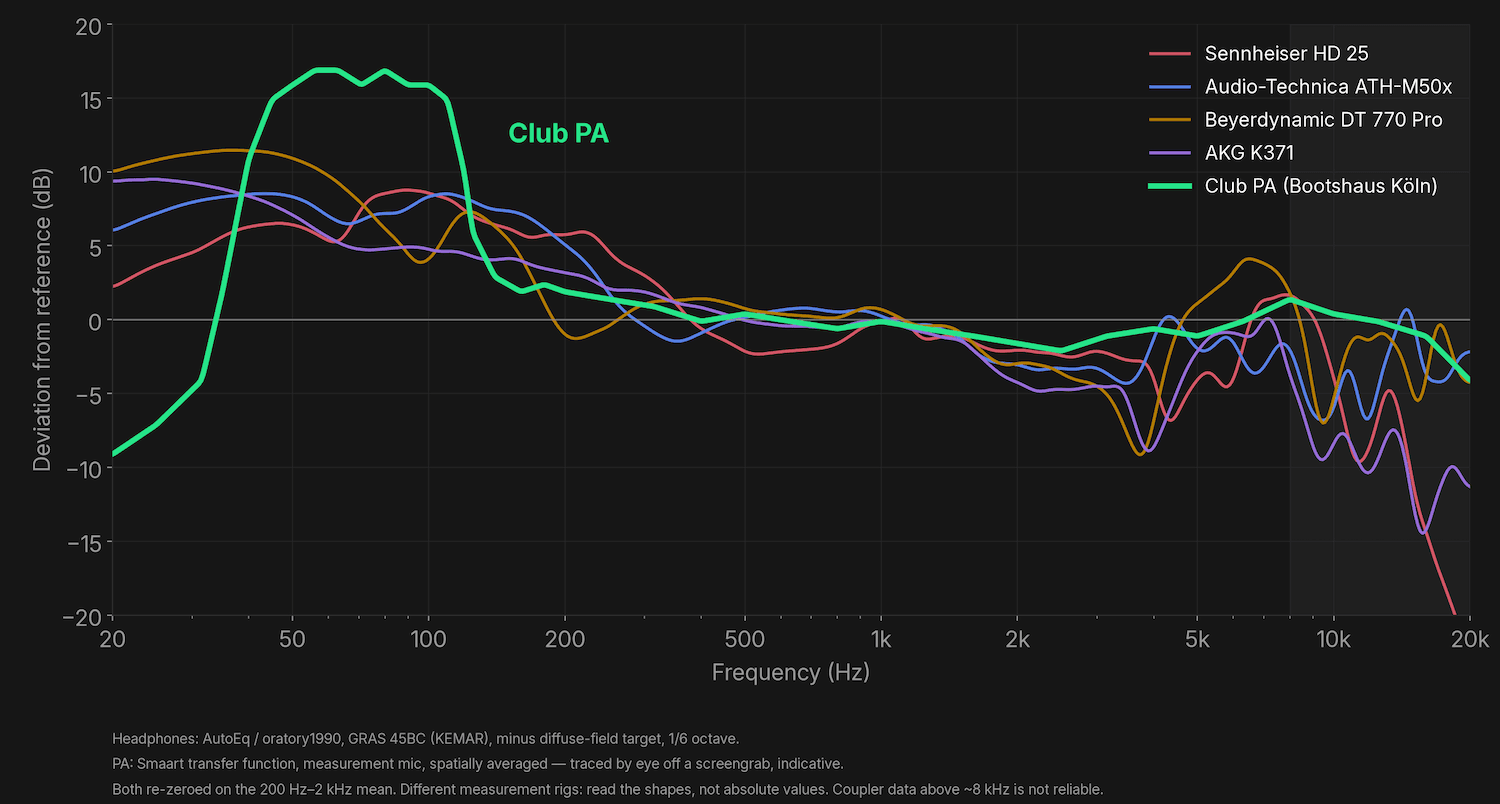
Frequency response of four common DJ headphones against an example club PA system
But a Linear Filter Cancels Out... Not Always!
A system's frequency response is a linear filter, the educated reader might say, and a linear filter colors every track in a match the same way. This is true. When two tracks carry a similar, broadband spectrum, that coloring cancels mostly.
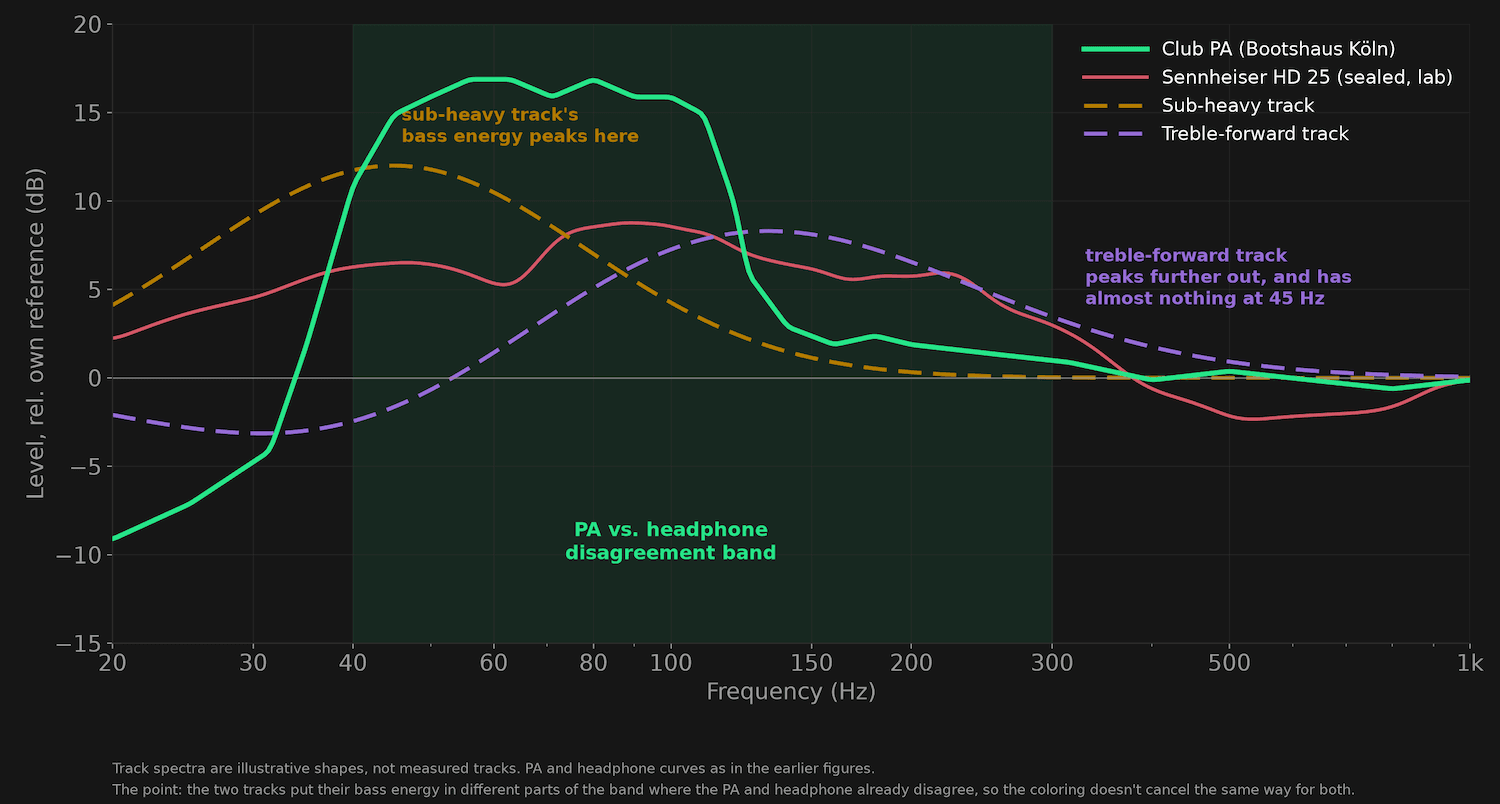
However, the cancellation only holds when both tracks spread their energy across the disagreement band in roughly the same way. Real tracks often don't: one track's bass energy peaks around 40 Hz, the next one's peaks at 60, 80, or even 120 Hz, and the PA-versus-headphone gap is anything but flat across that stretch.
Illustrative sub-heavy and treble-forward track spectra overlaid on the PA-vs-headphone disagreement band: the two tracks put their bass energy in different parts of the band where the PA and headphone diverge most
Pair a sub-heavy track against a treble-forward one, run through the actual measured PA and headphone curves, and the matching error comes out above 4 dB. A few dB is already very audible, and it's already more than a gain-knob feel can reliably correct for on the fly.
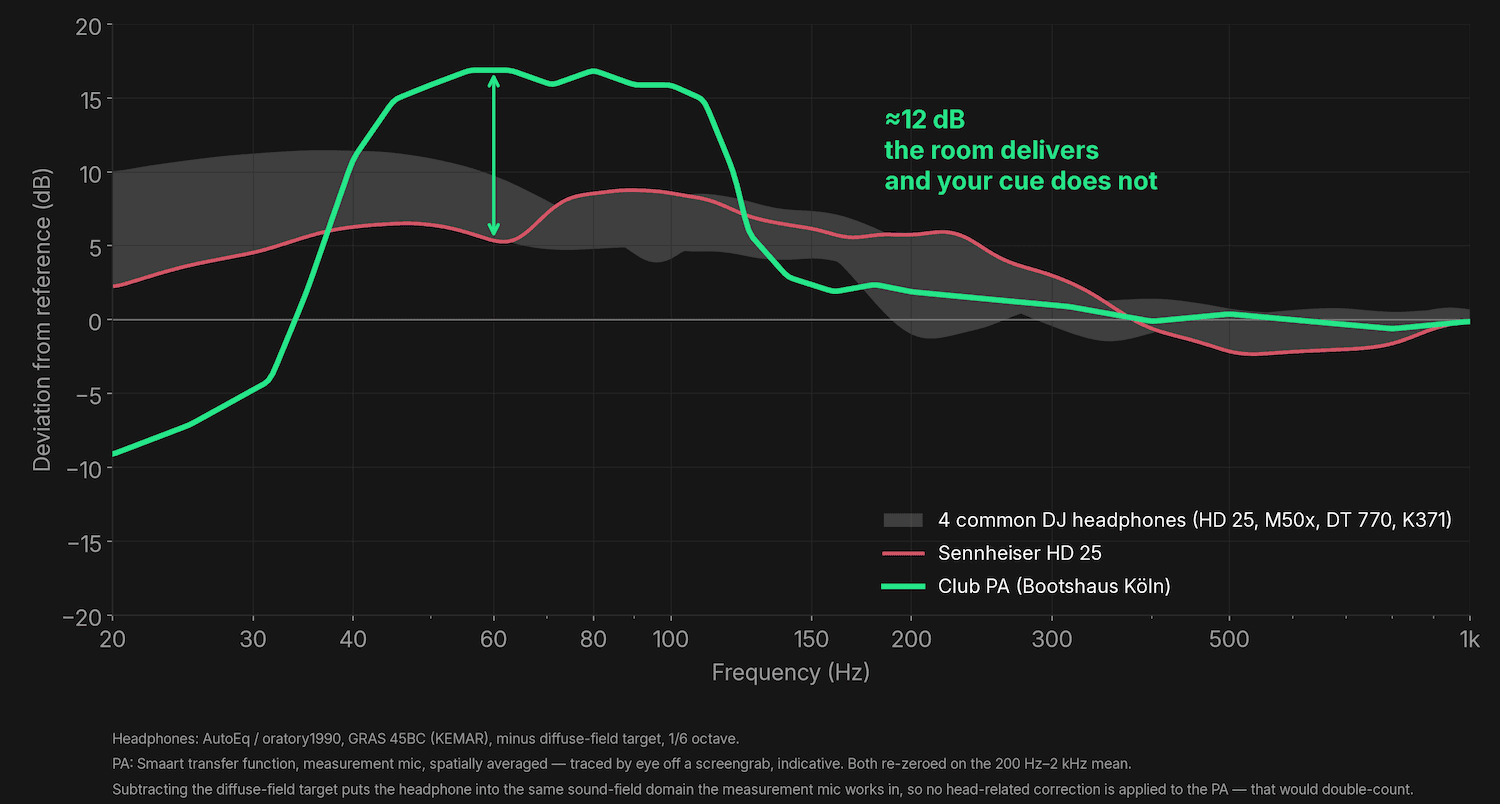
Common DJ headphones cluster within a few dB of each other in the bass; in this particular case the club PA sits roughly 12 dB above all of them from 40-120 Hz
It Gets Worse in a Real Booth
There are other parts to this that complicate the situation further.
Every Club PA Is Different
A DJ who learned to compensate for one room's coloring starts over in the next room, because every club PA has a different response. Consistency is not this industry's strong suit.
Your Ear Moves the Target Too
Equal-loudness contours are level-dependent (Fletcher-Munson): a DJ monitors at roughly 85-95 dB while the floor runs at 100-110 dB. You can't correct for that by comparing two signals, because it isn't a coloring applied to the signal at all. It's a change in your own hearing between two different volumes, and unlike a system's frequency response, it doesn't cancel at all.
A Real Seal Isn't a Lab Seal
A sealed headphone in a lab measurement is the best case. But in a real booth, seal quality varies, and above roughly 100 dB room SPL, the room's own bass leaks straight through the cups and masks whatever the cue is actually delivering. A sealed, silent-room match comes out under 1 dB off. A realistic booth pushes that toward +3 dB.
And the people arguing hardest for the gain knob in the comments are, statistically, judging that gain knob through a cap, a busted seal, and a couple of drinks. A broken seal alone costs over 10 dB at 40 Hz. Now try to compensate for that.
You're Judging Two Signals on Two Transducers, Loud, in Real Time
The comparison itself is a hard listening task on top of all that. The DJ is judging a cue against a track on the PA, on two different transducers, in real time, in a loud room. And absolute loudness judgment isn't stable over a set: it drifts with fatigue and with sustained SPL exposure.
The Gain Knob Isn't Going Away
None of this means the gain knob should go away. Taste, energy, and reading the room still belong to the DJ. It means the starting point for that gain knob shouldn't be a by-ear guess, because the guess isn't judging a fixed, learnable offset. It's judging a target that moves with whichever two tracks happen to be playing in whichever club.
Everyone has heard it: a transition in a club or at a festival where the two tracks just don't sit together. That doesn't ruin the set. People are still dancing, the DJ's still doing their job, it's still a great night. But once you start listening for those level jumps, you catch them everywhere, and they cost more than they seem to. A transition that's supposed to build energy instead resets it, because the incoming track landed a few dB hot or soft and the room feels it before anyone can name why.
Where These Numbers Come From
None of the numbers in this blog article are lab-grade, so here's where they come from. The PA curve is Bootshaus Köln, and we owe that one to AuftragSound! on YouTube, whose transfer-function walkthroughs of real club systems are the clearest breakdowns of what a PA is actually doing that we've found, worth watching on their own. We traced that curve off a screengrab by eye, not from raw measurement data, so treat it as a shape, not a spec sheet.
The headphone curves come from published coupler measurements (autoEQ), with each headphone's own diffuse-field target subtracted out first, so what's left is deviation from a neutral reference instead of the built-in shape of an ear canal. That's what makes them comparable to a measurement mic listening to a PA, which never had an ear in front of it to begin with.
Every graph here is built the same way: real measurements, aligned by hand, close enough to show the gap exists and roughly how big it is, not precise enough to tune a system off. That was never the point.
How waveAlign Fixes This
There's no reason to let the influence of masters that got louder and louder over the years be the thing that snags an otherwise clean transition, when a simple tool like waveAlign can fix that. waveAlign normalizes your entire track library to a consistent loudness level using LUFS, the same broadcast-standard measurement referenced throughout this article, so your starting point going into a set isn't a by-ear guess made under the exact conditions this article just walked through.
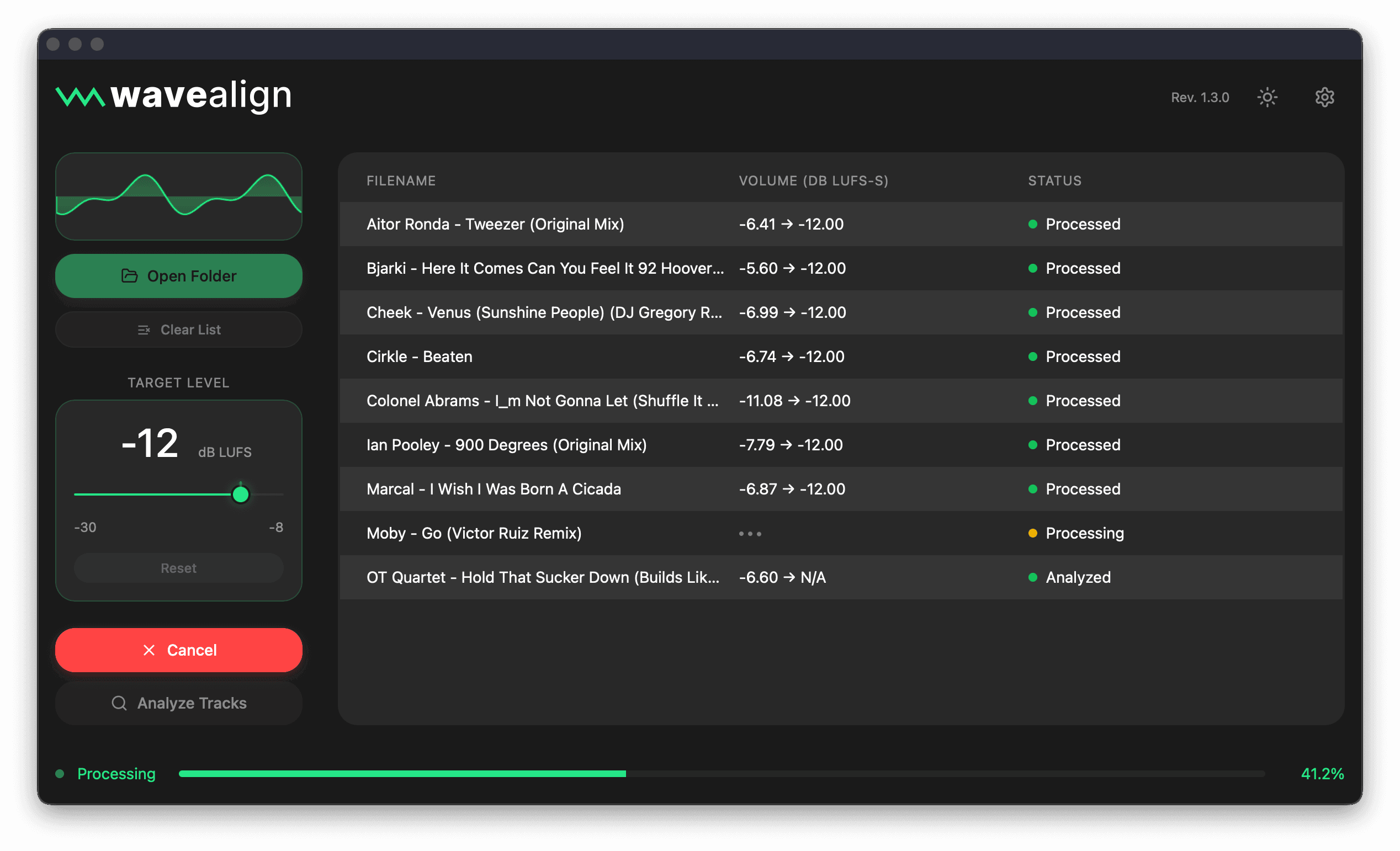
waveAlign focuses only on a track's loudness while leaving the sonic characteristics untouched
Prepping your library to a common loudness baseline beforehand is the safest, most professional way to start a set. waveAlign doesn't make you a better DJ. It just takes one variable out of the mix, and small fixes like that add up over a set. Your gain knob is still yours to use for taste, energy, and reading the room. It just isn't the thing doing the heavy lifting anymore.
Frequently Asked Questions
What does "loudness matching by ear" mean for a DJ? It's the practice of using the gain or trim knob to make an incoming track sound roughly as loud as the one currently playing, judged by listening in the headphones or booth monitors rather than by any measurement.
Why does loudness matching by ear sound accurate in the booth but off in the club? Because the DJ is judging the match on headphones or booth monitors, and those have a different frequency response than the club PA the crowd is actually hearing. A track that sounds matched on headphones can land several dB hot or soft once it comes out of the PA.
How much can a club PA and DJ headphones actually differ in the bass? In the measurements behind this article, club PA output ranged from a few dB to over 20 dB louder than common DJ headphones between 40 and 150 Hz, with one example club sitting around 12 dB above all four headphones tested in that range.
Does using waveAlign mean I don't need to touch the gain knob anymore? No. waveAlign normalizes your library's loudness ahead of time so your starting point is consistent, but the gain knob is still there for taste, energy, and adjusting to the room in the moment.
Is loudness matching by ear always wrong? Not always. Matching two similar-sounding, broadband tracks by ear tends to produce a small, mostly harmless error. The problem shows up when the two tracks put their energy in different parts of the frequency spectrum, which is common and not something you can predict by ear in advance.
Like what you see? Share with a friend.
Yannik Brehm
Yannik is a multifaceted professional whose career merges audio-engineering, software-development and music production. Currently working as a Senior Audio System Engineer specializing in automotive audio solutions and embedded development, he leverages a Master's degree in Media Informatics and experience in professional real-time audio software development for companies like Sennheiser. His technical expertise is complemented by practical knowledge and critical listening skills gained through years of producing, mixing and mastering electronic music.
Ready for perfectly balanced audio?
Try waveAlign and experience consistent loudness across your entire library.
Buy Now